Thursday, January 04, 2007
A Night At The Opera
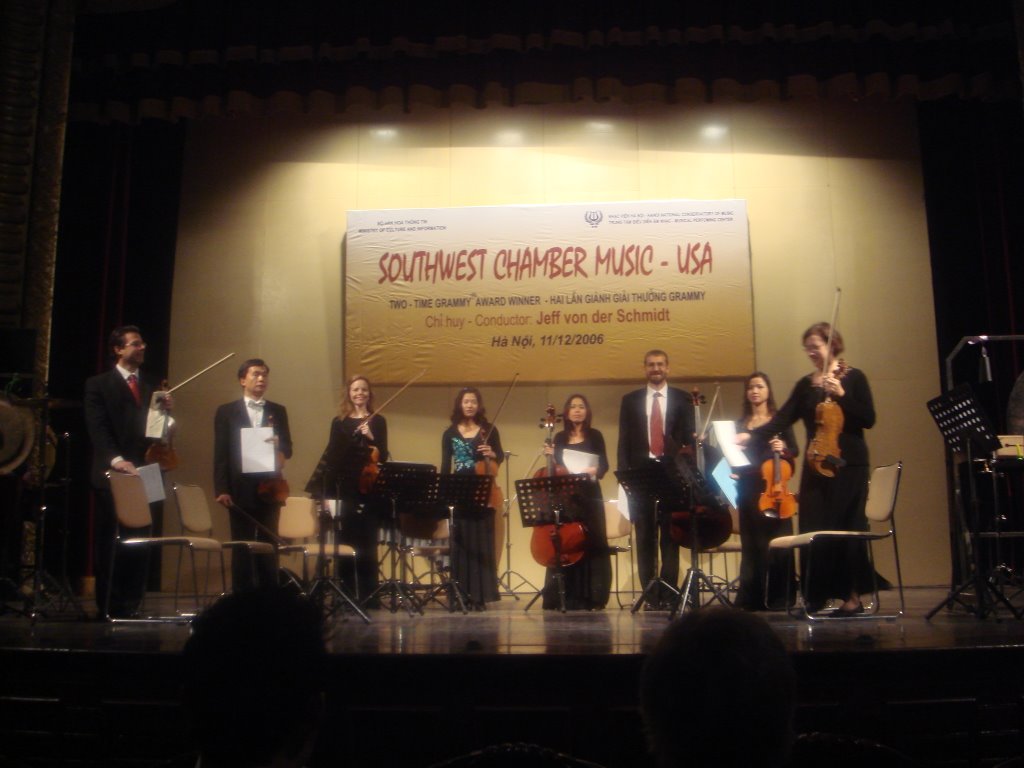 At 9 am, our Vietnamerican string octet is finally on stage of the charming 1911 French style ‘wedding cake’ opera house, giving the Mendelssohn it’s final polishing before the evening’s first public performance. Quite a sound in this visually resplendent gilt white & red velvet 500 seat venue, where every note can be heard with great clarity and warmth. The final run-through of Aura also went well, but with a few bumpy patches.
Though the work had been performed twice before on this tour, neither the loudly air-conditioned Phnom Penh venue nor the carnival-like Expo stage had really given the group the chance to present Aura in it’s best light, and clearly this was the time and the place. Some last minute changes were suggested by the composer (different voice dynamics, since this was a hall built for voices, and the addition of tuned water-filled crystal glasses originally called for in the score) along with various interpretational adjustments…business as usual for a new hall, and a maturing performance of a commissioned work. The temperature of the discussion grew as, among other things, the delicate issue of the players ‘saving themselves for the performance’ hampered the full realization of some ideas, and a few toes were gently trampled. But happily, the necessary friction produced more light than heat, as evidenced by the transcendent performance that evening. Also, a final run through of the opening Takemistu for 4 percussionists & 4 narrators fine-tuned that work as well, and it was on to lunch.
Some of the Octet members had already taxied their way across town to “Guan Nem” which specialized in a marvelous crab, shrimp & rice Spring Roll that was served with rice noodles and a special clear, chilled ginger sauce of soup-like consistency. Huge plates of fresh, savory herbs & greens accompanied each plate of steaming precut spring rolls from which we restocked our tiny bowls, such that each customized concoction produced a mélange which balanced the fresh & the fried, the green & the white, the hot & the cold. And unlike the previous night’s infamous fish house adventure, there was enough remaining for several players to leave with ‘doggy bags’, though that term is probably wildly inappropriate here, considering Peter’s revelation at lunch of witnessing some Cambodian canine grooming that was clearly gastronomic and not cosmetic in intent. Enough said.
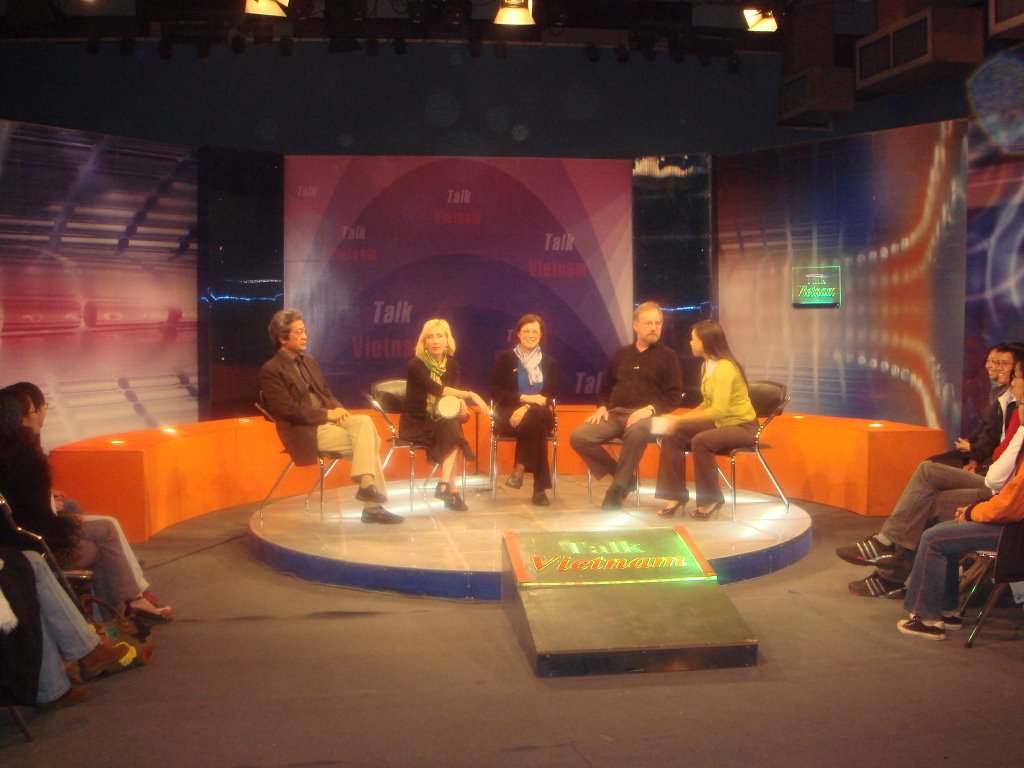
Jeff & Jan ventured in to the city for a very successful TV interview to be seen world-wide by the stations that service the international Vietnamese Diaspora, while others spent their last day finishing shopping lists, practicing, or resting up for the big finale. I used the time to finally spend an hour interviewing our constant traveling companion Dr. Him Sophy, whose beaming countenance has illuminated every room that he has entered since we first met him in Phnom Penh two weeks ago. A distinguished composer and teacher at the Royal University of Fine Arts, I learned more of his impending opera premiere in the States later this year, a work that tells the story of a Cambodian displaced by the Khmer Rouge, and his fascinating relationship with a (yes) rock star…looks like a sure hit, too. Like some of Chinary’s recent music, Dr. Sophy will also be mixing traditional Cambodian music with Western styles, but his opera also uses the electric guitars, keyboards and drums of popular music. It also turns out that the good Dr. is the author of an unpublished 500 page book on Cambodian classical music – written in Russian! (He did his graduate work in Moscow.) Remember that name – we’ll be reading about him in the American newspapers soon, I’m sure.
Concert call at 7:30 at the Opera – the percussion stations are all set for Takemitsu’s The Seasons which opens the evening. The Green room is abuzz with players warming up, running those difficult passages one last time, final equipment checks, tie & hem straightenings, all under the watchful gaze of the gigantic golden bust of Ho Chi Minh, whose massive mahogany pedestal has been relegated to a rather forgotten back stage corner. After a few brief formal salutations by the appropriate dignitaries, our last concert in this extraordinary Asian tour begins.
And it is the best night ever – having seen countless temples, towers and other sacred structures crowned with four-faced visages whose gazes embrace the four cardinal directions, it is only appropriate to begin this historic evening with Takemitsu’s planetary evocation “The Seasons”. Four percussionists are stationed across from one another on stage, each armed with a bewildering battery of noisemakers made of glass, metal, wood & stone (and a little plastic, too), creating undulating waves of sound ranging from the whisperingly quiescent to the tempestuous. The piece, which aspires toward world unity, was commissioned by the Osaka World’s Fair, and also includes four speakers (one per percussion station) who recite the Weather Report from four different parts of the world, in the appropriate language. Lynn Vartan led three Hanoi Conservatory percussionists, whilst I reported on American weather in AmerEnglish, Dr. Sophy was our Russian climatologist, and two speakers from the Conservatory reported in Vietnamese & German. The audience was complete enraptured.
There are very few chamber music groups that would dare to follow the hypermodernism of Takemitsu with the High Romanticism of the European 19th century, but then again, Southwest is renowned for their curatorial derring-do. Dare they did, and to great effect. To hear Mendelssohn’s passionate and difficult Octet performed at all is a treat, but to see it mastered by pairs of American and Vietnamese musicians added yet another layer of appreciation to a work which epitomizes the Western traditions of Classical Music. It has been said that one should either spend six months agonizing over every phrase, every bowing and every dynamic of this masterwork, or put it together in a day’s worth of rehearsals and let the work generate it’s own internal magic. That night, I believe that the audience was treated to the best of both worlds, though the musicians only had that week to prepare it (and a host of other offerings); the coherence with which hands, hearts and strings joined was nothing short of inspirational.
As has happened so often during this tour, the juxtaposition of the Asian, the European and the American was the exquisite spice that uniquely enhanced every musical offering. To experience a German Romantic composer performed by American & Vietnamese musicians in a French opera house built by Asian hands was the essence of this historic cultural exchange which illustrated the myriad economic, political and artistic complexities of the past. While those cultural cross references were perhaps only apparent between the ears of the beholders, the work that filled the second half clearly pointed towards the future by integrating elements both Eastern & Western, Ancient & Modern, even the Sacred & the Profane.
It turns out that Aura really is an opera, and it took a 500 seat wedding cake Parisian opera house in Hanoi (oh yes, and two years of preparation, recording and all of those other performances) to make this the most transcendent performance ever. The two solo voices took on a completely different relationship with the evocative chanted commentaries of the orchestra…the wine glasses exuded their unearthly emanations…the intimate acoustics allowed performers and audience alike to luxuriate over details that were too often masked (or swallowed by external circumstances) before, but in reality, there was really no explaining it. Why does Magic happen? Not just because the performers knew the work inside out, and were either exhausted or exhilarated into inspiration…or a Last Blast of Adrenaline knowing that this group wouldn’t be playing the piece again for a long time, hence giving it their ‘all’.
Or was it because, after two weeks of tasting the food, breathing the air, and sensing the history, all concerned were much closer to the elements which had inspired the composer, and this additional Asian perspective may have subconsciously inspired a truly enchanted performance. Chinary has told us that in the Cambodian tradition, musicians & dancers perform long meditations before imparting the cultural truths with which they have been entrusted, such that they will become the appropriate conduits for their respective art forms. Perhaps the past two weeks have been Southwest Chamber Music’s own Asian meditation, and in the telling of Chinary’s tale of the Buddha’s Enlightenment, we all left the 1911 Hanoi Opera House, and returned home the next morning, with our feet a little bit higher off the ground.

