Thursday, December 07, 2006
Elephants, Angkor and the World Culture Expo
Sunday, December 3
Up an hour earlier today and out the door at 8am to make it to the elephant ride. We take a different route than yesterday and pass some palatial old-style hotels, more construction, and the Children’s Hospital, home of the famed Beatocello. Seems that the resident Swiss doctor Beat Richner is also an amateur cellist, and every Saturday night at 7:30, he plays the Bach Cello Suites to raise money for the hospital. So out in front of the institution are huge signs, and posters with closeup photos of a cello and an infirm infant. The concerts are evidently a great success: how wonderful – another meeting of East and West as Bach helps save the children of Cambodia from dengue fever and other common blights.
Speaking of health, one down and none to go (if we’re lucky!). Lisa the violinist is the first and hopefully last to succumb to some sort of food poisoning. About fifteen minutes after dinner, things just didn’t seem right, and they weren’t. A rough night followed by a day of sleep got her on stage by the afternoon soundcheck, but just barely.
------------------
Entering the walled city of the thousand year old Khmer Empire was truly awe-inspiring. The walls have also kept out modernity – though in reality, the jungle did a pretty good job of that until the French stumbled upon the wildly overgrown ruins in the mid 19th century, and folks have been digging & pruning ever since. The sheer magnitude of the structures, let alone their exquisite design and function, is simply mind boggling. Our trip planners have wisely introduced us to these Wonders of the World in an order that ranks Least to Best preserved, so that by the time we arrive at Cambodia’s Crown Jewel tomorrow, Angkor Wat will fill in all the blanks that centuries of looting and dilapidation have robbed from so many other sites.
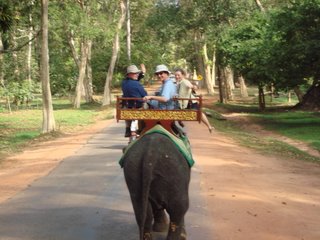 Climbing onto our elephants, we approach the gate that protects Angkor Thom three at a time, swaying and plodding at a medieval pace while awkwardly turning backwards to try to photograph the next trio. After all, no one is really going to believe that you rode an elephant in Cambodia unless you have proof, right? The pachydermal pace does help erase the 21st century left behind us,, though we are still passed on the road by the mosquito- like buzzing of everpresent scooters. It is hard to imagine that these walls held over a million people a thousand years ago, and that the arts, culture, astronomy and architecture far outstripped anything found in Europe at the time.
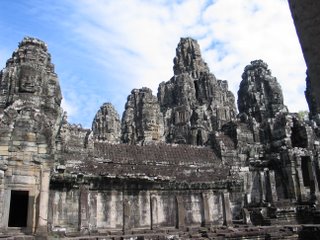 Upon alighting, we turn to see the 54 towers of Bayon, each of which is crowned with four giant faces of the Avalokiteshvara (the god of compassion) facing in the cardinal directions. The sandstone faces turn out to be Jayavarman VII himself, the king who constructed this amazing temple in the exact center of Angkor Thom. Images of Indiana Jones or Tomb Raider immediately spring to mind as we climb the grand ruined entrance and enter the temple which is ringed by elaborate bas-relief carvings that tell of daily life in what was once a teeming metropolis. Deep within, Buddhist shrines glow with candlelight and burning incense, each attended by a supplicant who hands you 3 glowing sticks, eager to show you how to bow to the statue which is adorned with saffron robes. Except for the shuffling of tourist feet, and they are legion, you may well be in another century, for at this moment, time has stopped.
After an hour of exploration and actual wall climbing (how long are they going to let us do that!?! Stonehenge is now fenced off, and for good reason), we meet the bus in front of a few souvenir stalls. A tro (Cambodian 2-string fiddle) catches my eye, and I turn to Susan Ung for advice. She may be one of our two Western violists, but she is also a master of these Asian bowed instruments, having played them professionally for years. The vendor hands Susan the instrument, trying to show her how to hold it, but soon backs away amazed as beautiful music begins to pour out of its tiny soup can sized body. A crowd quickly gathers, the locals astonished that a “tourist” knows their fiddles so well. Chinary gives the nod to this particular instrument, deemed of very high quality, and a few minutes of haggling puts it in my hands for keeps. (Now how the hell do I get it home?) But the music isn’t over: a few hand drums hang nearby, and Lynn Vartan and Chinary do a little improvisation to the consternation of all. Never a dull moment with C.U. around!
The Terrace of Elephants is next, a huge reviewing stand that faces the large now empty parade grounds, carved with parading elephants along with some garudas. The scale of the place outstrips Washington DC by a mile, especially when you remember the century of its use…
But too soon we are back on the bus and returning to Siem Reap [which means “Siam Flattened” by the way…a constant reminder of the Thai’s intimate relationship with Angkor through the ages and even recently] to lunch, nap, and prepare for the World Expo.
If you have ever attended a World’s Fair, those international booster events that used to get thrown every four or so years, you can easily imagine the format of the Angkor-Gyeongju World Culture Expo 2006. South Korea, Asia’s other capitalist wunderkind, pairs up with a different country on a regular basis to heighten mutual awareness and develop both business and consumer ties. For the first time ever, Cambodia is being featured – a huge development for this nation that has known profound suffering until very recently (the American War, Pol Pot) and is struggling mightily to rejoin the family of nations. A third of Cambodia’s population now live below the U.N. poverty limit, while the Danish Red Cross reports that in Cambodia and surrounding countries, somewhere between 250,000 and 400,000 women are sold every year for prostitution and forced labor because the society has not been able to find a place for them. At present, tourism is Cambodia’s best hope for economic revival, and Koreans will send at least 300,000 this year.
Enter the World Expo.
To celebrate the 10th anniversary of the establishment of diplomatic relations between Cambodia & South Korea, each country has provided Culture Pavilions, food booths, shops, Folk Game Courts, and concerts for fifty days of celebration. There is even a 3D film theatre featuring special dramatizations of each country’s mythical origins. All in all, twenty-eight countries are participating in this Expo, and Southwest Chamber Music is the only American ensemble performing at this historic event, made all the more special because of their performance of Chinary Ung’s music.
The concert is scheduled as the evening’s main event, and the large outdoor covered stage is covered with microphones so not a moment would be missed. After a meticulous 4p.m. sound check, all is ready to go, so many of the players cruise the Expo grounds until showtime. During the scant two hours that precede our concert, an amazing array of performances are available on the smaller outdoor stages that are scattered around the fairground. Stage #2 offered a Chinese Cheng quartet (that country’s version of the koto), with the young women beautifully coifed and dressed, their singing and plucking accompanied by a traditional court drum. Simultaneously on a stage a few hundred feet away was a troop of Korean dancers, exuberant with their hand held drums & cymbals, not to mention the twirling banners attached to their hats and their lithe acrobatics. Near that was a trio of Mung musicians playing folk music on amplified tube zither, tro and voice. And for the kiddies, a carnival complete with ferris wheel and games. All amplified, and all going at the same time.
Remember that.
7pm rolls around and, as if on cue, the full moon slowly rises above the Grand Stage, as Hollywood style movie searchlights sweep the sky (and there’s even a full-blown Angkor Wat backdrop behind the band!). The hundreds of seats are filled with wide-eyed visitors both local and foreign, and the four plush leather armchairs that are set directly in front of the Grand Stage are finally occupied by government dignitaries which include the Kingdom of Cambodia’s Secretary of State and the Vice Chairman of the Expo. There are ceremonial welcomes, a few short speeches appropriate to the magnitude of the occasion, and the show begins.
The Mozart Flute Quartet in D-major opens the program, beautifully played of course, but it becomes immediately clear that something is a bit ‘off’. All of the other events are still going full tilt, with their concomitant hubbub cheerfully joining in with the elegant chamber music. Undaunted, the players carry on, and luckily, so does the audience, entranced by every note. The Mozart Clarinet Quintet follows, with no change in ambience, as the amplification carries every note to its intended destination.
 Then the piece de resistance, Chinary Ung’s Aura. After a few quick remarks from the Master of Ceremonies, the composer and the conductor, the magic begins. And so does an outdoor film a few hundred feet away! But Southwest prevails, and all else simply evaporates from the audience’s consciousness. The performance was, to my ears, one of the most spirited and inspirational to date. In spite of the heat, the wind, and the extravagant menagerie of insect life that seemed to be drawn almost magnetically to the sheet music (some of the players actually sprayed Deet on their seats and stands), the power of the score was inescapable. Forty five minutes later, the crowd stood in deep appreciation, as the dignitaries went on stage to shake hands with Chinary & Jeff, bestowing each with large bouquets, and the soprani with flowers and gifts. The television interviews that followed were broadcast the following day on National TV.
Both exhilarated and exhausted by the challenges of the evening, the players headed off to a marvelous dinner hosted by our gracious donors who are traveling with us, Ellen and Harvey Knell, Sue Bienkowski and Wang Chung Lee (who are also joined by the rest of the donor group of Patsy Neu and Ken Garen). The evening finishes with the revelation that Chinary not only an exquisite composer, but a master at table entertainment. If you are ever lucky enough to be sitting next to him at dinner, simply hand him two forks, two toothpicks and a water glass, and get ready for a delightful surprise. And if you ever wondered how to retrieve (with one finger only, now!) a dollar bill from under a pile of quarters while it balances on top of a bottle…
Up an hour earlier today and out the door at 8am to make it to the elephant ride. We take a different route than yesterday and pass some palatial old-style hotels, more construction, and the Children’s Hospital, home of the famed Beatocello. Seems that the resident Swiss doctor Beat Richner is also an amateur cellist, and every Saturday night at 7:30, he plays the Bach Cello Suites to raise money for the hospital. So out in front of the institution are huge signs, and posters with closeup photos of a cello and an infirm infant. The concerts are evidently a great success: how wonderful – another meeting of East and West as Bach helps save the children of Cambodia from dengue fever and other common blights.
Speaking of health, one down and none to go (if we’re lucky!). Lisa the violinist is the first and hopefully last to succumb to some sort of food poisoning. About fifteen minutes after dinner, things just didn’t seem right, and they weren’t. A rough night followed by a day of sleep got her on stage by the afternoon soundcheck, but just barely.
------------------
Entering the walled city of the thousand year old Khmer Empire was truly awe-inspiring. The walls have also kept out modernity – though in reality, the jungle did a pretty good job of that until the French stumbled upon the wildly overgrown ruins in the mid 19th century, and folks have been digging & pruning ever since. The sheer magnitude of the structures, let alone their exquisite design and function, is simply mind boggling. Our trip planners have wisely introduced us to these Wonders of the World in an order that ranks Least to Best preserved, so that by the time we arrive at Cambodia’s Crown Jewel tomorrow, Angkor Wat will fill in all the blanks that centuries of looting and dilapidation have robbed from so many other sites.
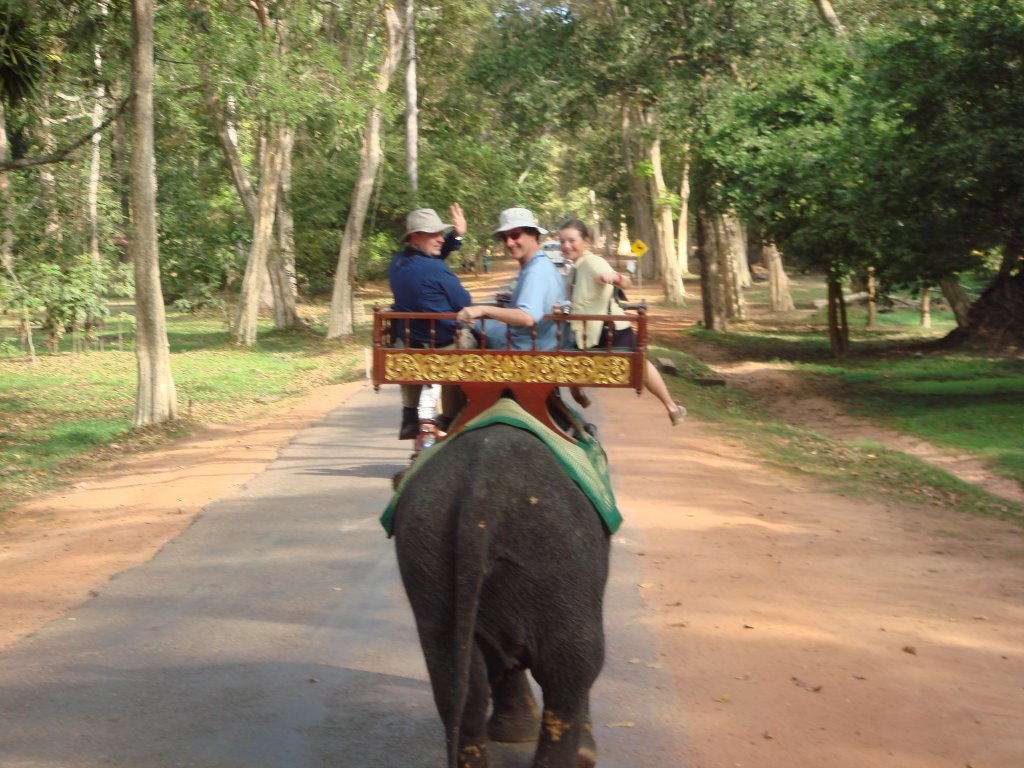 Climbing onto our elephants, we approach the gate that protects Angkor Thom three at a time, swaying and plodding at a medieval pace while awkwardly turning backwards to try to photograph the next trio. After all, no one is really going to believe that you rode an elephant in Cambodia unless you have proof, right? The pachydermal pace does help erase the 21st century left behind us,, though we are still passed on the road by the mosquito- like buzzing of everpresent scooters. It is hard to imagine that these walls held over a million people a thousand years ago, and that the arts, culture, astronomy and architecture far outstripped anything found in Europe at the time.
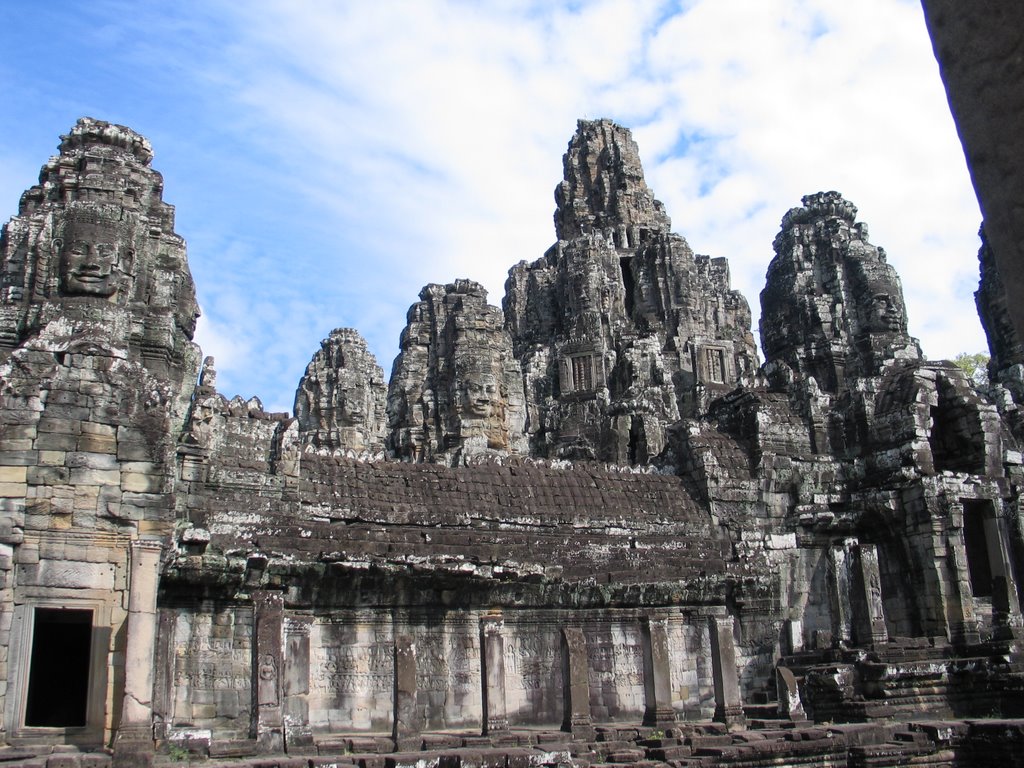 Upon alighting, we turn to see the 54 towers of Bayon, each of which is crowned with four giant faces of the Avalokiteshvara (the god of compassion) facing in the cardinal directions. The sandstone faces turn out to be Jayavarman VII himself, the king who constructed this amazing temple in the exact center of Angkor Thom. Images of Indiana Jones or Tomb Raider immediately spring to mind as we climb the grand ruined entrance and enter the temple which is ringed by elaborate bas-relief carvings that tell of daily life in what was once a teeming metropolis. Deep within, Buddhist shrines glow with candlelight and burning incense, each attended by a supplicant who hands you 3 glowing sticks, eager to show you how to bow to the statue which is adorned with saffron robes. Except for the shuffling of tourist feet, and they are legion, you may well be in another century, for at this moment, time has stopped.
After an hour of exploration and actual wall climbing (how long are they going to let us do that!?! Stonehenge is now fenced off, and for good reason), we meet the bus in front of a few souvenir stalls. A tro (Cambodian 2-string fiddle) catches my eye, and I turn to Susan Ung for advice. She may be one of our two Western violists, but she is also a master of these Asian bowed instruments, having played them professionally for years. The vendor hands Susan the instrument, trying to show her how to hold it, but soon backs away amazed as beautiful music begins to pour out of its tiny soup can sized body. A crowd quickly gathers, the locals astonished that a “tourist” knows their fiddles so well. Chinary gives the nod to this particular instrument, deemed of very high quality, and a few minutes of haggling puts it in my hands for keeps. (Now how the hell do I get it home?) But the music isn’t over: a few hand drums hang nearby, and Lynn Vartan and Chinary do a little improvisation to the consternation of all. Never a dull moment with C.U. around!
The Terrace of Elephants is next, a huge reviewing stand that faces the large now empty parade grounds, carved with parading elephants along with some garudas. The scale of the place outstrips Washington DC by a mile, especially when you remember the century of its use…
But too soon we are back on the bus and returning to Siem Reap [which means “Siam Flattened” by the way…a constant reminder of the Thai’s intimate relationship with Angkor through the ages and even recently] to lunch, nap, and prepare for the World Expo.
If you have ever attended a World’s Fair, those international booster events that used to get thrown every four or so years, you can easily imagine the format of the Angkor-Gyeongju World Culture Expo 2006. South Korea, Asia’s other capitalist wunderkind, pairs up with a different country on a regular basis to heighten mutual awareness and develop both business and consumer ties. For the first time ever, Cambodia is being featured – a huge development for this nation that has known profound suffering until very recently (the American War, Pol Pot) and is struggling mightily to rejoin the family of nations. A third of Cambodia’s population now live below the U.N. poverty limit, while the Danish Red Cross reports that in Cambodia and surrounding countries, somewhere between 250,000 and 400,000 women are sold every year for prostitution and forced labor because the society has not been able to find a place for them. At present, tourism is Cambodia’s best hope for economic revival, and Koreans will send at least 300,000 this year.
Enter the World Expo.
To celebrate the 10th anniversary of the establishment of diplomatic relations between Cambodia & South Korea, each country has provided Culture Pavilions, food booths, shops, Folk Game Courts, and concerts for fifty days of celebration. There is even a 3D film theatre featuring special dramatizations of each country’s mythical origins. All in all, twenty-eight countries are participating in this Expo, and Southwest Chamber Music is the only American ensemble performing at this historic event, made all the more special because of their performance of Chinary Ung’s music.
The concert is scheduled as the evening’s main event, and the large outdoor covered stage is covered with microphones so not a moment would be missed. After a meticulous 4p.m. sound check, all is ready to go, so many of the players cruise the Expo grounds until showtime. During the scant two hours that precede our concert, an amazing array of performances are available on the smaller outdoor stages that are scattered around the fairground. Stage #2 offered a Chinese Cheng quartet (that country’s version of the koto), with the young women beautifully coifed and dressed, their singing and plucking accompanied by a traditional court drum. Simultaneously on a stage a few hundred feet away was a troop of Korean dancers, exuberant with their hand held drums & cymbals, not to mention the twirling banners attached to their hats and their lithe acrobatics. Near that was a trio of Mung musicians playing folk music on amplified tube zither, tro and voice. And for the kiddies, a carnival complete with ferris wheel and games. All amplified, and all going at the same time.
Remember that.
7pm rolls around and, as if on cue, the full moon slowly rises above the Grand Stage, as Hollywood style movie searchlights sweep the sky (and there’s even a full-blown Angkor Wat backdrop behind the band!). The hundreds of seats are filled with wide-eyed visitors both local and foreign, and the four plush leather armchairs that are set directly in front of the Grand Stage are finally occupied by government dignitaries which include the Kingdom of Cambodia’s Secretary of State and the Vice Chairman of the Expo. There are ceremonial welcomes, a few short speeches appropriate to the magnitude of the occasion, and the show begins.
The Mozart Flute Quartet in D-major opens the program, beautifully played of course, but it becomes immediately clear that something is a bit ‘off’. All of the other events are still going full tilt, with their concomitant hubbub cheerfully joining in with the elegant chamber music. Undaunted, the players carry on, and luckily, so does the audience, entranced by every note. The Mozart Clarinet Quintet follows, with no change in ambience, as the amplification carries every note to its intended destination.
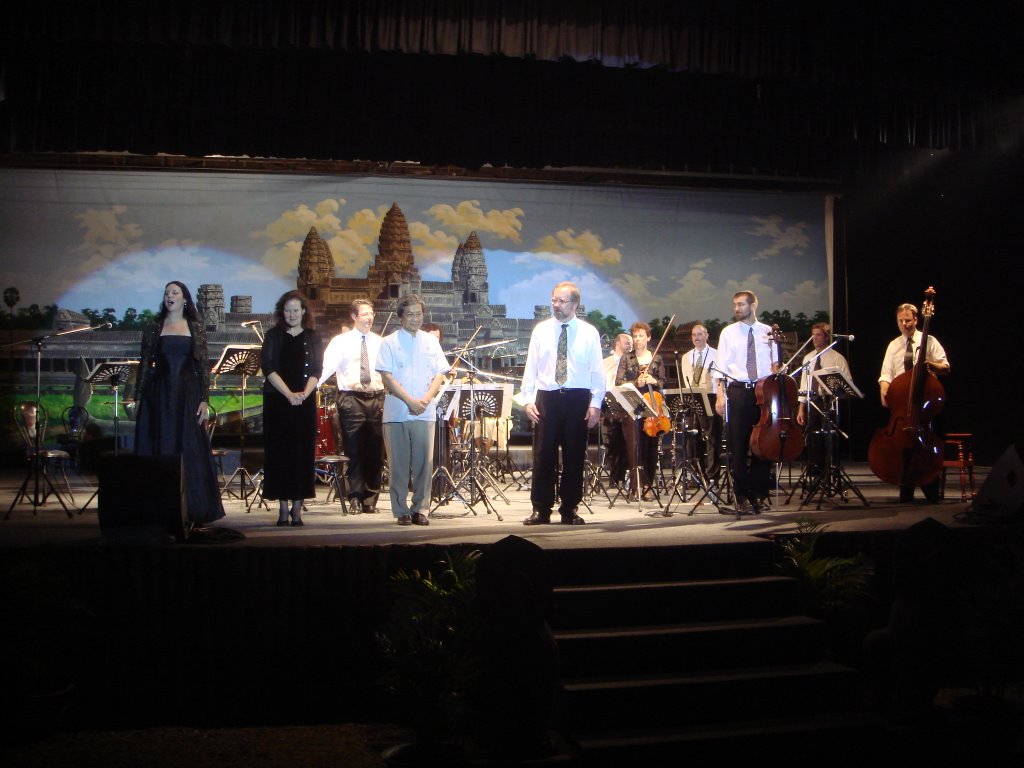 Then the piece de resistance, Chinary Ung’s Aura. After a few quick remarks from the Master of Ceremonies, the composer and the conductor, the magic begins. And so does an outdoor film a few hundred feet away! But Southwest prevails, and all else simply evaporates from the audience’s consciousness. The performance was, to my ears, one of the most spirited and inspirational to date. In spite of the heat, the wind, and the extravagant menagerie of insect life that seemed to be drawn almost magnetically to the sheet music (some of the players actually sprayed Deet on their seats and stands), the power of the score was inescapable. Forty five minutes later, the crowd stood in deep appreciation, as the dignitaries went on stage to shake hands with Chinary & Jeff, bestowing each with large bouquets, and the soprani with flowers and gifts. The television interviews that followed were broadcast the following day on National TV.
Both exhilarated and exhausted by the challenges of the evening, the players headed off to a marvelous dinner hosted by our gracious donors who are traveling with us, Ellen and Harvey Knell, Sue Bienkowski and Wang Chung Lee (who are also joined by the rest of the donor group of Patsy Neu and Ken Garen). The evening finishes with the revelation that Chinary not only an exquisite composer, but a master at table entertainment. If you are ever lucky enough to be sitting next to him at dinner, simply hand him two forks, two toothpicks and a water glass, and get ready for a delightful surprise. And if you ever wondered how to retrieve (with one finger only, now!) a dollar bill from under a pile of quarters while it balances on top of a bottle…
# posted by Southwest Chamber Music @ 6:42 AM 
Comments:
<< Home
Hi, i was looking over your blog and didn't
quite find what I was looking for. I'm looking for
different ways to earn money... I did find this though...
a place where you can make some nice extra cash secret shopping.
I made over $900 last month having fun!
make extra money now
Post a Comment
quite find what I was looking for. I'm looking for
different ways to earn money... I did find this though...
a place where you can make some nice extra cash secret shopping.
I made over $900 last month having fun!
make extra money now

<< Home
